
Is It Safe to Breastfeed After Breast Augmentation in San Francisco?
Overview
The short answer is yes. The vast majority of women breastfeed successfully after breast augmentation.
With subfascial placement, the implant sits under the skin, under the breast tissue, and under the fascia. The nerves to the nipple and the milk ducts are well above the implant, which is why breastfeeding complications after augmentation are exceedingly rare.
Incision placement and surgical technique affect how well glandular tissue is preserved, and I discuss this with every patient who is planning a family.
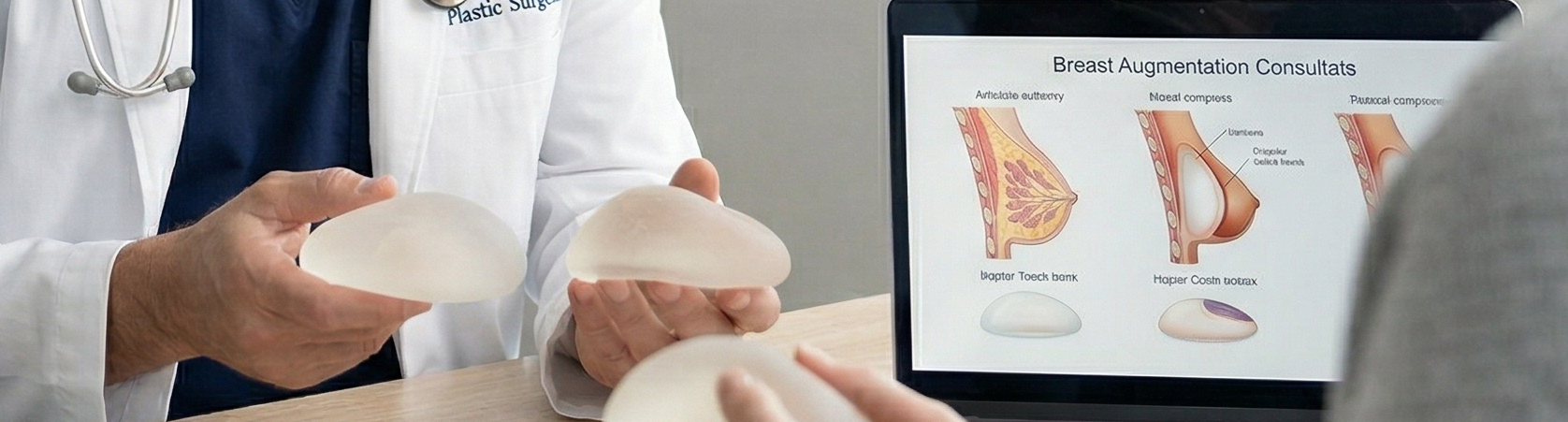
A plastic surgeon during a breast augmentation consultation in an office setting.png
1. Why Implants Do Not Typically Interfere With Breastfeeding
The easiest way to think about this is that the implant goes under the skin, under the breast tissue, and under the fascia of the muscle. The nerves that supply sensation to the nipple travel close to the nipple within the breast tissue itself, so they are well above the implant. The milk ducts are in that same layer. When I place an implant using the subfascial approach, the functional anatomy responsible for breastfeeding is not in the surgical field.
Pressure on the milk ducts from swelling or the implant itself explains why, in rare cases, breastfeeding becomes difficult after augmentation. But that assumes you are breastfeeding relatively soon after surgery, which is not a realistic scenario. No plastic surgeon is going to perform a breast augmentation on a woman who is actively breastfeeding or about to deliver. By the time a patient becomes pregnant and starts nursing, the surgical area has long since healed. Difficulty breastfeeding after augmentation is a known complication, but it is exceedingly rare. [LINK: What Should You Know Before Your Breast Augmentation Consultation in San Francisco?]
2. Does the Incision Location Matter?
It does, though the risk differences are small. I prefer the inframammary approach for the majority of my patients.
Inframammary (under the breast crease): accesses the breast from below, avoiding the milk ducts and glandular tissue entirely
Periareolar (around the nipple): goes through breast tissue near the nipple, which carries a slightly increased risk of affecting lactation, though that risk is still low
Transaxillary (armpit): avoids breast tissue but offers less direct visibility during surgery
3. How Implant Placement Affects Breastfeeding
Subfascial placement keeps the implant in a layer that is completely separate from the breast tissue where milk production and nerve function happen. A patient from the Marina came in specifically because she wanted augmentation but was planning to start a family within two years. We discussed how subfascial placement and an inframammary incision would preserve function, and she went on to nurse both of her children without difficulty. That outcome is the norm. [LINK: Redefining the San Francisco Silhouette: 5 Essentials of Modern Breast Augmentation]
4. Are Silicone Implants Safe for Nursing?
The FDA has reviewed this extensively, and there is no evidence that silicone implants pose a risk to nursing infants. Silicone is an inert material, and studies have found no higher levels of silicon in the breast milk of women with implants compared to women without them.
5. Nipple Sensation and the Let-Down Reflex
The let-down reflex, which triggers milk release when the baby latches, depends on nerve signals from the nipple. Temporary changes in nipple sensation after augmentation are common and typically resolve within a few months. Permanent sensation loss is rare, particularly with the inframammary approach and subfascial placement, because the sensory nerves run through the breast tissue above the implant and are not disturbed during surgery.
6. Will Pregnancy Change Your Augmentation Results?
Pregnancy itself causes hormonal changes that engorge breast tissue and stretch the skin. After weaning, some volume loss and skin relaxation is normal regardless of whether you have implants. Some patients notice their results look slightly different after pregnancy, and in some cases a revision or lift makes sense down the road. I set this expectation during the consultation so the distinction between pregnancy changes and implant issues is clear. [LINK: San Francisco Breast Augmentation FAQ: 15 Top Questions Answered Clearly]
7. Should You Wait Until After Having Children?
There is no medical requirement to wait. Many of my patients across San Francisco and the East Bay enjoy their results for years before becoming pregnant and breastfeed without issues. If you are planning to become pregnant in the next 6 to 12 months, it is sometimes worth discussing timing, but this is a personal decision rather than a clinical one.
Myths Worth Correcting
"Implants make breastfeeding impossible." The functional anatomy for breastfeeding sits above the implant in a completely different tissue layer. The vast majority of augmented women nurse without any issues.
"Silicone leaks into breast milk." FDA research has found no evidence of this.
"You have to choose between implants and nursing." With the right incision and placement, the two are fully compatible for the vast majority of patients.
Frequently Asked Questions
-
I recommend waiting at least 3 to 6 months so your body has fully healed and your implants have settled into their final position.
-
Yes, always let them know. Your OB and any lactation consultants should be aware of your augmentation so they have the full picture.
-
Not necessarily, and this varies by individual. Some patients are happy with their results after pregnancy, while others notice enough change that a revision or lift makes sense. I see patients from Pacific Heights to Marin for post-pregnancy assessments, and the conversation is always honest about whether additional surgery is warranted.
-
Implant size alone is not a significant factor. What matters more is the placement, incision approach, and how well the glandular tissue and nerve supply are preserved during surgery.
-
Implants do not prevent mammograms, but let your radiology technician know so they use Eklund displacement views. This is standard practice across the Bay Area.
-
A breast lift involves repositioning the nipple, which carries a slightly higher risk of ductal disruption compared to augmentation alone. Modern techniques keep the nipple attached to its blood supply and nerve connections, preserving breastfeeding potential in most cases. If both procedures are needed and breastfeeding is a priority, I walk through the tradeoffs during the consultation. [LINK: Planning Your New Silhouette: A Guide to Visualizing Breast Rejuvenation in the Bay Area]
-
The same way any new mother monitors supply: by tracking feeding frequency, wet diapers, and weight gain at pediatric checkups. A lactation consultant is a valuable resource in the first few weeks regardless of whether you have had augmentation, and I recommend scheduling one before delivery so you have support lined up.
-
Nothing specific to the implants themselves. The standard guidance around positioning, latch technique, and feeding frequency applies the same way. If you experience any unusual firmness or discomfort in the breast tissue while nursing, let both your OB and my office know so we have the full picture.
Summary
Breast augmentation and breastfeeding are compatible for the vast majority of patients. With subfascial placement, the implant sits below the breast tissue, milk ducts, and sensory nerves, which is why complications are exceedingly rare. If breastfeeding is a priority, an informed conversation during your consultation is the best way to address your specific anatomy and concerns.
Have Questions About Breastfeeding After Augmentation?
Call 415-362-1846 to schedule a consultation at my San Francisco office at 450 Sutter Street, Suite 1440, or at my Alameda location at 1403 Park Street.
[LINK: How Should You Plan Your Breast Augmentation Recovery in San Francisco?]
Follow and Connect with me on my social media!