
Will Botox Freeze My Face? The Truth Behind Common Myths in Alameda

Overview
The biggest misconception about Botox is the frozen look. Good work goes unnoticed. When someone tells you that you look well-rested, that is the result I am after.
Botox is a temporary muscle relaxer, not a filler.
Stopping treatment does not make wrinkles worse than before.
You do not need to be a certain age to start.
Men and women require different doses and different brow shapes.
Cheap Botox deals often involve diluted or counterfeit product.
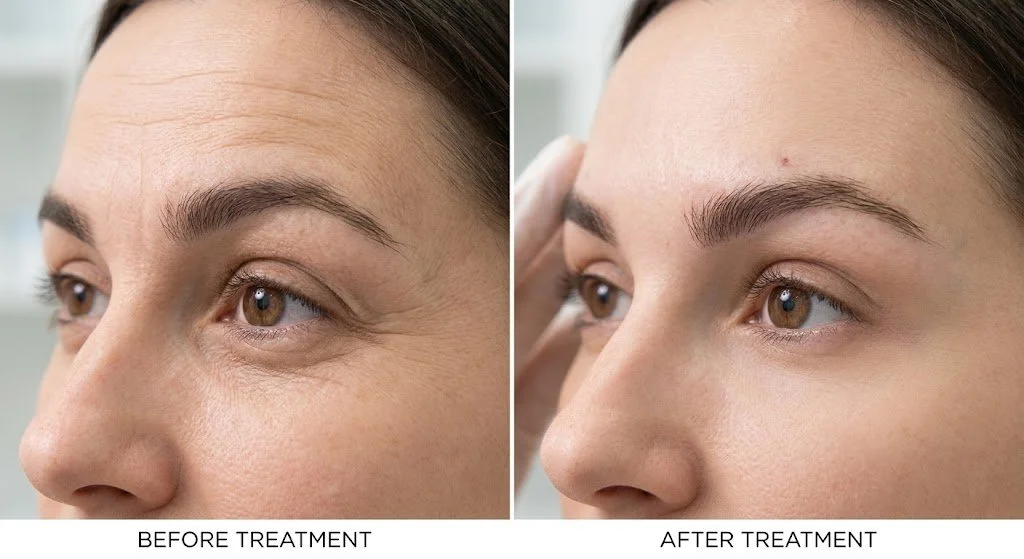
1. The Results Look Different on Everyone
I hear this fear almost every week at my Alameda office. A new patient sits down, looks a little nervous, points to her forehead, and says, "I want these lines gone, but please don't make me look like [insert frozen celebrity name here]."
I get it. We have all seen the bad results: eyebrows that don't move, a shiny plastic forehead, a smile that doesn't reach the eyes. But here's the truth. That frozen look is not an inherent property of Botox. It's a sign of poor dosing or poor placement, and it happens when an injector uses too much product or treats the wrong muscles.
My goal is to soften the lines while keeping your natural expression intact. I want you to look like you slept for twelve hours, not like a wax figure. In the industry we call this "active" Botox, meaning I leave enough muscle function for you to raise your eyebrows when you're surprised and frown when you're angry. You don't etch those lines deeper into your skin while doing it.
Anatomy varies widely. Some patients have a strong frontalis (the big muscle across your forehead), while others have strong corrugators (the muscles that create the 11 lines between the brows). A cookie-cutter approach fails. I customize the dose to your specific muscle strength and expression pattern.
2. The "Poison" Myth and Safety Realities
"Isn't this stuff toxic?" I get asked this often, and it's a fair question. The name sounds scary, and people associate it with food poisoning. Let's separate fact from fear. Botox is a neuromodulator, a purified protein derived from a bacterium. It's not live bacteria, and it's not snake venom.
The mechanism is straightforward. It blocks the signal from the nerve to the muscle. The nerve says "contract," the muscle doesn't get the memo, and the skin on top stays smooth.
The safety profile is well-established. This medication has been used clinically since the 1970s to treat muscle spasms, strabismus (crossed eyes), and cerebral palsy in children. The cosmetic doses we use are minuscule compared to those therapeutic ones.
Think of Tylenol. Take two, your headache goes away. Take the whole bottle, you damage your liver. The dose makes the poison. In the hands of a board-certified plastic surgeon, the safety margin is enormous. And of course, patient safety is the first thing I think about with any prescription injectable, so your overall health is the most important thing!
3. The Fear of Stopping Treatment
A patient asked me recently, "Dr. Kim, if I start this now, do I have to do it forever? Will my face sag if I stop?"
This is one of the most persistent Botox myths I hear. There's a fear that the face will crash or age rapidly the moment the product wears off, and it isn't true.
Here is what happens when you stop:
The product metabolizes out of your system over roughly three to four months.
Your nerves resume signaling, and your muscles wake up and contract normally again.
The lines you had before gradually reappear at their previous baseline.
You return to where you started. You do not look worse.
In fact, you might look slightly better than you would have otherwise. For the time you used the product, you paused the etching process and gave your skin a break from constant folding and creasing.
I had a patient who moved away from the Bay Area for two years and stopped her treatments. When she came back to see me, she looked like herself. She had some lines, sure, but she did not have sagging skin caused by a lack of Botox. Nothing is permanent, and that's the beauty of neuromodulators.
4. It's Not Only for Wrinkles
Many people think neuromodulators are purely cosmetic, only for crow's feet and forehead lines. That's an outdated view. I use Botox for functional, quality-of-life issues as often as cosmetic ones. Three of the most common medical applications in my practice:
Masseter reduction for teeth grinding. Bruxism is widespread in Silicon Valley and the East Bay, where stress levels run high. Patients clench their jaws at night, which leads to cracked teeth, morning headaches, and an overgrown, square lower jaw. I inject Botox into the masseter muscle to weaken the clench. Over time the muscle shrinks because it isn't working as hard, which also slims the lower face.
Hyperhidrosis treatment. For patients with excessive underarm sweating, Botox blocks the signal from nerve to sweat gland. It's a life-changer for Financial District professionals who worry about sweating through a dress shirt during a presentation.
Chronic migraine prevention. The FDA approved Botox for chronic migraines in 2010. It relaxes the muscles around the head and neck that drive tension headaches, and for the right patient it dramatically reduces both frequency and severity.
If you're dealing with jaw pain, tension headaches, or sweat that you've written off as "just how I am," call my office at 415-362-1846. The fix might be medical rather than cosmetic.
5. The Bargain Trap and Counterfeit Product
We need to talk about price. You'll see ads for "Cheap Botox" or Groupon deals that look too good to be true. Be careful.
This is a medical procedure involving an injection into your face. It is not the place to hunt for the lowest bidder. When the price is drastically below market, ask yourself:
Is the product diluted with extra saline?
Is it a counterfeit product imported illegally from overseas?
Is the injector a nurse with two weekends of training, or a physician with real anatomy knowledge?
I have seen the results of bargain injections. Ptosis, a droopy eyelid, is the most common consequence of poor technique, and it lasts for months. It is not worth the fifty dollars you saved.
You are not paying for the liquid in the bottle. You are paying for 25 years of experience holding the needle, knowledge of facial anatomy, and assurance that the product is authentic and dosed correctly for your face.
6. Men and "Bro-tox"
The idea that cosmetic procedures are only for women is outdated. I see plenty of men in my Alameda and San Francisco offices, and the demographic has been shifting for years.
Men usually have different goals. They don't want a perfectly smooth forehead. They want to look less angry, less tired, more approachable in the office. Deep frown lines between the brows read as aggressive or stressed in a conference room, and in the business world that matters.
The technical approach differs too. Men typically have stronger, larger facial muscles, so the standard 20 units that softens a woman's corrugators often doesn't touch a man's. I dose higher. I also keep the brow line flatter rather than arched, because a lifted, arched brow reads feminine and that's rarely what a male patient wants.
Here is how the protocols typically compare:
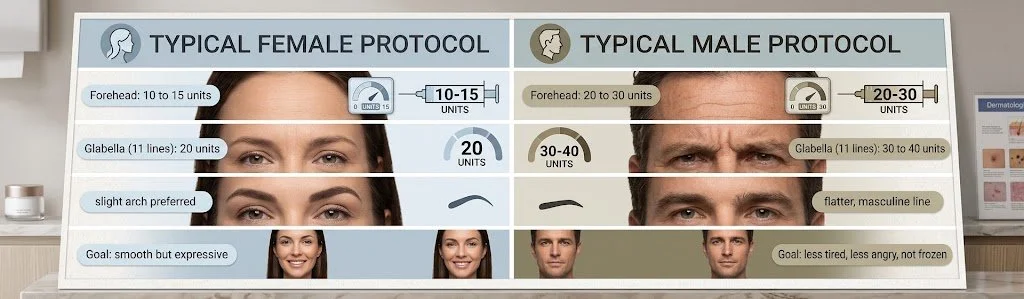
Every patient is different, and these ranges shift based on muscle strength, starting anatomy, and individual goals. The numbers above are a starting framework, not a recipe.
Quick Myth-Buster
Myth: Botox accumulates in your body over time. No. It's metabolized and cleared within three to four months. There is no buildup.
Myth: Once you start, you have to continue forever. False. Stop whenever you want. Your face reverts to baseline, nothing more.
Myth: It migrates around the face unpredictably. With proper technique and appropriate dilution, it stays where it's placed. Migration is a technique problem, not a Botox problem.
Myth: Botox and Dysport and Letybo are identical. They are all neuromodulators, but the molecules differ in size, diffusion, and onset. I use Botox most often, with Letybo as a strong alternative for patients who want variety or who have developed resistance.
Frequently Asked Questions
-
For most patients in their 30s and 40s, a standard forehead treatment lasts three to four months. Masseter Botox for teeth grinding tends to last longer, often four to six months, because the muscle is larger and the turnover is slower. Results shorten slightly if you exercise heavily or have a fast metabolism.
-
The needle is extremely fine, smaller than the needle used for a flu shot. Most patients describe it as a series of quick pinches. I use ice or a topical numbing cream for patients who are needle-averse, and the whole treatment typically takes under ten minutes.
-
I generally start preventive or baby Botox in patients in their late 20s if they already have visible dynamic lines at rest. For patients whose skin still bounces back completely when they relax their face, there is no benefit to starting early. Age is less important than what your skin and muscles are doing.
-
You'll notice softening around day three or four. Full effect settles in at about two weeks. I always schedule a touch-up appointment at the two-week mark for new patients, so we have room to adjust anything that came in asymmetric or under-dosed.
-
Skip the gym and alcohol for the rest of the day. Both increase blood flow to the face and tend to worsen bruising. Keep your head upright for four hours, avoid lying flat or rubbing the treated areas, and return to normal activity the next morning.
-
If a dose lands asymmetrically, I usually correct it with a small touch-up at your two-week follow-up. If you decide you don't like the look overall, the product wears off on its own in a few months. Unlike filler, there is no dissolver, but there is also nothing permanent to undo.
-
Both. I see patients at 1403 Park Street in Alameda and at 450 Sutter Street, Suite 1440 in San Francisco. The same protocols, same products, and same injector at both locations.
Summary
The frozen face fear is a technique problem, not a Botox problem. In skilled hands, a well-placed neuromodulator softens lines without erasing expression, and it walks back out of your system cleanly if you decide it isn't for you. The range of applications now extends well past wrinkles into jaw tension, migraines, and excessive sweating. What separates a good result from a bad one is not the product in the syringe. It is the person holding it, and the knowledge of anatomy and dosing behind the hand.
Schedule Your Consultation in Alameda
If you are thinking about Botox for the first time, or you want to refine a protocol that has been inconsistent, I see patients at both offices.
Call 415-362-1846 or email info@drkim.com to set up a time.
San Francisco: 450 Sutter Street, Suite 1440, San Francisco, CA 94108
Alameda: 1403 Park Street, Alameda, CA 94501
Follow and Connect with me on my social media!