
When Should I Get Botox Before a Big Event? An 8-Week Plan for Alameda Patients
Overview
The ideal window to schedule Botox before a major event is 4 to 6 weeks in advance.
Do not wait until the week of your wedding or reunion. Neuromodulators need time to bind to the receptors and quiet the muscle. Results are not instant.
Here is the quick breakdown:
Full results take 14 days to appear.
Touch-up buffer of 2 weeks is non-negotiable for big events.
Bruising resolves in 3 to 10 days if it happens.
First-time patients need extra time to adjust to the feel of a quieter muscle.
1. The Biology of the Waiting Period
I see a specific panic in patients' eyes when they come into my Alameda office three days before a wedding. They want smooth skin for the photos, they want the frown lines gone, and they want it yesterday. I have to tell them the hard truth. It is too late.
Botox is not a filler. It does not physically fill a wrinkle the moment I inject it. It is a neuromodulator, and it works by interrupting the signal between the nerve and the muscle. The chemical process is slow. When you leave my chair, you look almost exactly the same as when you walked in, aside from a few tiny red bumps at the injection sites, and your forehead still moves.
Most patients notice a decrease in movement around day three or four. The peak effect, where the muscle is fully relaxed and the skin smooths out, lands around day 14. I call this the Two Week Rule. If you have an event on Saturday and you get injected on Wednesday, you will have full forehead movement in your photos. You have wasted your money for that specific event.
Beyond the biology, there is a settling period. Your facial muscles need to learn their new balance. The frontalis muscle in the forehead often fights the toxin for the first week, which sometimes creates temporary unevenness. A proper buffer lets everything soften and look natural.
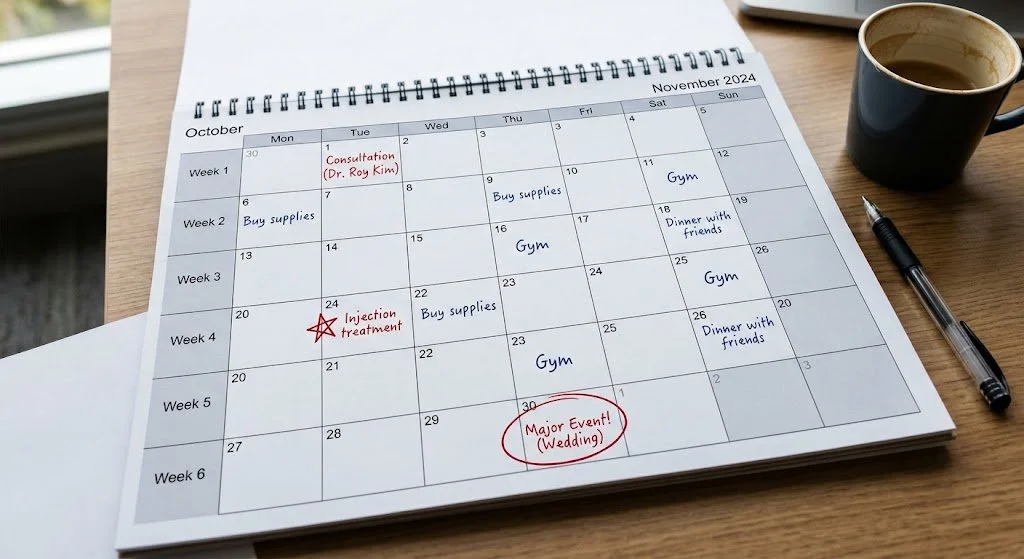
2. The 8-Week Countdown Plan
To get the best result for a wedding or reunion, you need a strategy. I prefer to work backward from the event date, whether you are the bride, the mother of the bride, or a guest who wants to look rested.
Week 8: The Consultation
Come see me two months out, especially if I have never treated you before. I need to see how your face moves at rest and in expression, and I need to see your skin quality. Sometimes patients think they need Botox when the right answer is a laser treatment or a small amount of filler. Once we decide on neuromodulators, we lock in the injection date.
Week 6: The Injection Appointment
This is the sweet spot. We perform the injections now, which gives the product two full weeks to kick in completely. It also places your event in the window where the Botox is most effective but has softened slightly. You will not look frozen. You look rested.
Week 4: The Review and Touch-Up
This step is non-negotiable for big events. You come back to my office, and I ask you to make a mean face and to raise your brows. We look for asymmetry. One eyebrow might arch higher than the other. A small area of the corrugator might still be pulling. I add a few units where needed to perfect the result.
Week 2 to Event Day: Cruise Mode
You are done. The touch-up has settled, any tiny bruise from the needle has faded, and your skin looks smooth. You do not have to think about appointments or recovery. You focus on the party.
[READ HERE: How Long Does Botox Last? Understanding the Duration]
Whether the event is in Alameda, San Francisco, or across the East Bay, this timeline removes the stress. You already have enough to worry about with catering and guests. Your face should not be on that list.
3. Why First-Timers Need a Longer Runway
I treat seasoned Botox patients differently than I treat first-timers. If you have been seeing me at 450 Sutter or on Park Street for five years, I know your anatomy. I know your left brow likes to pull up, I know exactly how many units you need, and we have a rhythm.
With a new patient, you are a blank page. Everyone has unique anatomy. Some people have strong muscles that require higher doses, others are sensitive and need a baby Botox approach.
I had a patient last year who came in for her son's wedding. She had never had a cosmetic treatment in her life and she was nervous. She came in six weeks early, which was perfect. We did a conservative dose. Two weeks later, she felt the effect was too subtle. Because we had time, I added a few more units. She looked fantastic for the wedding.
If she had come to me one week before, I would have been forced to guess. Too high, and she feels frozen in her photos. Too low, and she is disappointed.
If this is your first time, do not test drive a new face the week of your wedding. The feel of a quieter muscle is unfamiliar at first, and you need time to get used to it and to learn how to smile with your eyes. Give yourself the full eight weeks.
4. The Risk of Bruising and Spock Brows
We use needles, and whenever a needle enters the skin there is a risk of bruising. It does not matter how skilled the injector is or how thin the needle is. If the needle catches a small capillary, you get a bruise.
Most bruises are small, a tiny pinprick or a faint smudge, and makeup covers them easily. Occasionally a patient gets a larger, darker bruise, and those take 7 to 10 days to fade.
Picture a dark purple bruise on your forehead two days before your wedding. No amount of concealer hides that texture and color on camera. Injecting 4 to 6 weeks out eliminates this variable. Even the worst bruise disappears in two weeks.
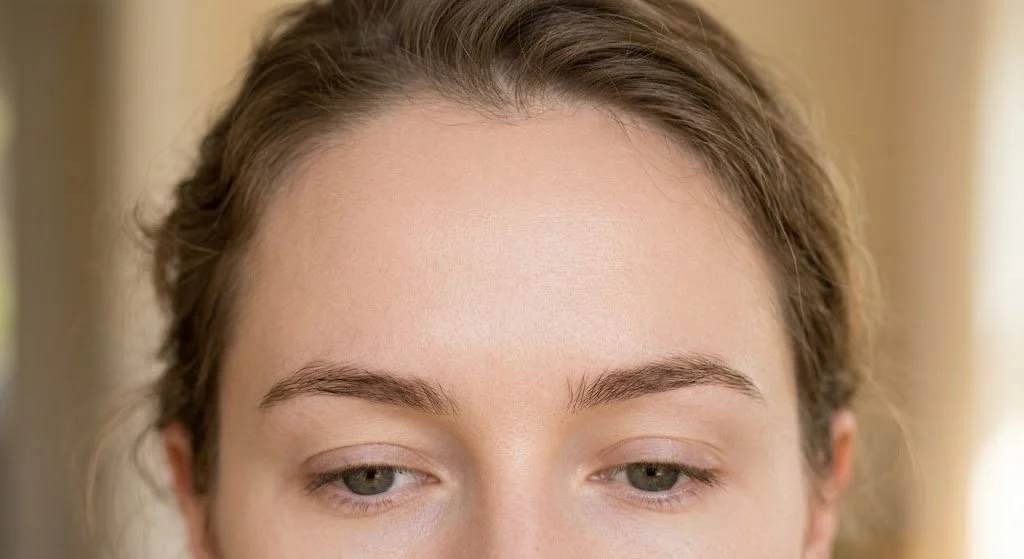
Then there is the Spock brow. This happens when the outer part of the frontalis pulls up while the center stays relaxed, and you look surprised or angry. It is an easy fix. A tiny amount of product in the active muscle drops it within days. But you need time to spot it and fix it. If you wake up with a Spock brow the morning of your event, you are stuck with it for the photos.
Preparation is risk management. We want zero surprises on the big day.
5. Combining Treatments for the Glow
Botox handles muscles. It does not handle skin texture. Many of my Alameda patients want the glass skin look for their events, and that usually means combining neuromodulators with other treatments like chemical peels, lasers, or dermal fillers.
Timing becomes even more critical here. You generally do not do lasers and Botox on the same day, because the swelling from a laser treatment affects how the toxin spreads.
My preferred sequence for event prep:
8 to 10 weeks out: Address volume loss with fillers first, since fillers cause more swelling and bruising than Botox.
6 to 8 weeks out: Address skin quality with lasers or peels.
6 weeks out: Finalize muscle movement with Botox.
1 week out: Gentle facial or hydration treatment only.
Do not try a new aggressive chemical peel the week of the event. I have seen patients with peeling, red skin trying to apply foundation over it. It looks dry and flaky on camera. Stick to gentle, hydrating facials close to the date, and save the heavy lifting for two months out.
If you are planning a full refresh, we sit down and look at the calendar together. We map the sequence, account for downtime, and make sure you look like the best version of yourself, not a swollen version of yourself.
[READ HERE: Dermal Fillers vs. Botox: Which One Do You Need?]
Ready to Build Your Timeline?
If your event is on the calendar, now is the time to plan. Call my Alameda office at 415-362-1846and we will build a timeline that has you looking rested, natural, and camera-ready on the day that matters.
Myths About Pre-Event Botox
Myth: "If I get Botox the day before, it will kick in fast enough."
No. The product needs roughly 14 days to reach its full effect. One day before gets you nothing except possible bruising.
Myth: "More units mean faster results."
Dose affects how strong and how long, not how fast. Higher doses still follow the same onset curve.
Myth: "Botox will make me look frozen in my wedding photos."
Done correctly, it softens lines and preserves expression. Frozen faces come from heavy-handed dosing, not from Botox itself.
Myth: "I should skip Botox if I have sensitive skin."
Neuromodulators act on muscle, not on skin. Sensitive skin is rarely a reason to avoid treatment. The injection sites heal quickly.
Frequently Asked Questions
-
Two weeks is the hard cutoff, and I push back on anything closer. At the two-week mark the product has reached full effect, and if something needs a correction, we have zero runway. A bruise might still be visible. If a patient insists on injections less than two weeks before a major event, I usually decline. The risk of an unhappy result in the photos is too high. Better to have a few lines and look like yourself than to look uneven or bruised.
-
If you get injected the day of the rehearsal dinner, yes. Alcohol thins the blood and dilates small vessels, which raises the bruising risk at the injection sites. I tell patients to avoid alcohol for 24 hours before and 24 hours after the appointment. If you follow the 6-week plan, you were injected weeks before any wedding festivities, and champagne on the big day is a non-issue for your forehead.
-
It changes the aftercare, not the long-term timeline. Avoid heavy exercise for 24 hours after injection. A raised heart rate and blood pressure increase bruising risk and, in theory, shift product before it binds. After the first day, resume your normal routine. If you are a marathon runner or CrossFit regular with a wedding on the calendar, plan the injection for a rest day.
-
Short flights the next day are fine. Cabin pressure does not affect how Botox works. I ask patients to avoid lying flat or rubbing the face for 4 hours after injection, so a red-eye the same evening is not ideal, but a flight the following morning is fine.
-
It depends on your anatomy, your goals, and the areas we are treating. A glabella-only treatment might run 20 to 25 units. A full upper face with forehead, glabella, and crow’s feet usually lands in the 40 to 60 unit range. We decide together at the consultation. I never sell by unit count. I treat by result.
-
This is why the 6-week timeline exists. If something is off at the two-week check, we have options. I add units to drop a high brow, balance asymmetry, or soften a forehead line that is still pulling. What I cannot do is reverse Botox. Once it is in, we wait it out. That is why conservative first doses and a built-in touch-up visit matter so much.
Summary
Timing is everything with pre-event Botox. Six weeks out is the sweet spot for injections, with a touch-up visit at the four-week mark and a full two-week settling window before the event. First-time patients should plan on eight weeks. Skip the day-before panic appointments. Build a plan, allow for bruising and touch-ups, and sequence any combination treatments so everything peaks together. The goal is a face that looks like yours on its best day, not a face that looks like it was worked on yesterday.
Book Your Pre-Event Consultation
Weddings, reunions, and milestone birthdays deserve a proper plan.
My office sees patients at both the San Francisco location at 450 Sutter Street, Suite 1440, and the Alameda location at 1403 Park Street.
Call 415-362-1846 to schedule a consultation, and we will map out your timeline together.
Follow and Connect with me on my social media!