
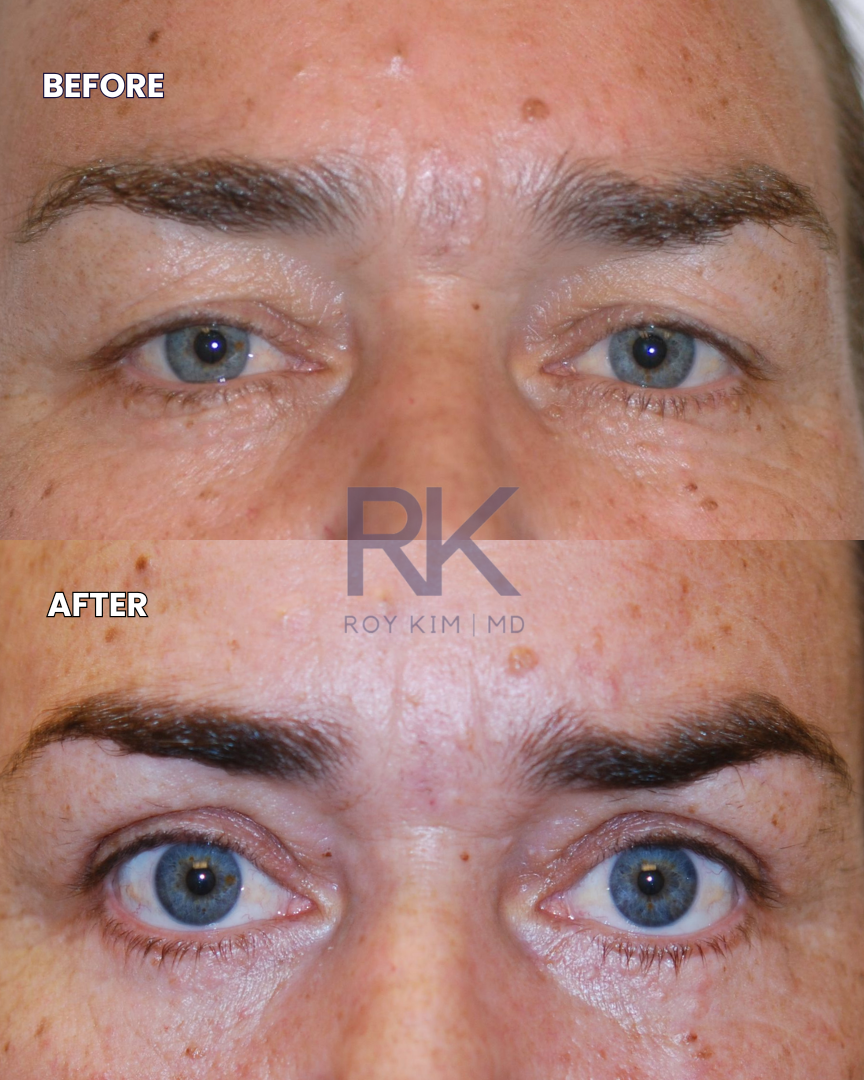
Overview
Upper blepharoplasty recovery is usually straightforward, but may take time, since the eyelid skin is quite thin. Swelling and bruising are most noticeable during the first several days, and most patients look socially presentable again in about 7 to 14 days.
You may feel ready to return to normal activities before your eyelids look completely normal. Mild swelling, incision redness, tightness, and subtle asymmetry can continue for several weeks, while the scars and eyelid crease may keep improving for months.
This article focuses on what to expect after upper eyelid surgery. For a broader overview of eyelid surgery, including candidacy, upper versus lower blepharoplasty, and results, see my San Francisco blepharoplasty guide.
1. What Happens During the First 24 to 48 Hours?
Swelling is usually the biggest issue early in recovery.
Your upper eyelids may look puffy, the incisions can appear red, and bruising may develop around the eyes. Swelling can actually increase during the first day before it begins improving.[2]
Mild tightness, irritation, tearing, temporary blurred vision from ointment, and dry eyes can also occur.
Pain after an isolated upper blepharoplasty is usually not severe. Significant or rapidly increasing pain is different and should not simply be assumed to be part of normal recovery.
Your plastic surgeon may recommend cold compresses, keeping your head elevated, eye lubrication, and limiting activity during this early period.
2. What Should I Expect During the First Week?
The first couple of days are the worst, and swelling and bruising improves over the next several days.
Bruising can extend below the eyes even though the surgery was performed only on the upper eyelids. The eyelids can also look somewhat uneven because swelling is almost never perfectly symmetrical. That does not necessarily mean the final result will be asymmetric.
Depending on how the incision was closed, sutures are commonly removed sometime during the first week or shortly afterward.[3]
Most patients are comfortable walking around and doing ordinary activities well before they look completely recovered.
3. When Will I Look Normal After Upper Blepharoplasty?
For many patients, 7 to 14 days is the practical social-recovery window. By that point, much of the obvious bruising and swelling has usually improved.
The American Society of Plastic Surgeons similarly notes that many eyelid-surgery patients are presentable in public within approximately 10 to 14 days.[1]
There is an important distinction, however, between being presentable and being completely healed. Residual swelling can persist longer, particularly in the morning. The eyelid crease may initially look unusually high or tight. The incision can remain pink, slightly firm, or more noticeable than expected.
These changes generally continue improving over the following weeks and months.
4. When Can I Exercise Again?
This depends on the exact operation you had, your body’s metabolism, and your plastic surgeon's postoperative protocol.
Strenuous exercise, heavy lifting, bending, and activities that substantially increase blood pressure are usually restricted during the early recovery period because bleeding around the eye is one of the complications surgeons want to avoid.[2]
Walking is generally encouraged much earlier.
I would follow your surgeon's specific instructions rather than deciding that the eyelids "look good enough" and returning immediately to intense exercise.
5. Are Dry Eyes Normal After Upper Blepharoplasty?
Temporary dryness, irritation, tearing, or a gritty sensation can occur after upper eyelid surgery.
Swelling can temporarily affect blinking and how completely the eyelids close. Patients who already have dry-eye symptoms deserve particular attention before surgery.
Temporary difficulty completely closing the eyes, called lagophthalmos, can also occur. Excessive removal of skin or muscle can increase this problem, which is one reason conservative tissue removal and careful surgical planning matter.[4]
Most temporary symptoms improve as swelling resolves, but persistent or significant eye symptoms should be evaluated.
6. What Are the Main Risks of Upper Blepharoplasty?
Upper blepharoplasty is generally a well-tolerated operation, but it is still surgery.
Potential complications include bleeding, infection, dry eyes, difficulty completely closing the eyes, unfavorable scarring, asymmetry, undercorrection or overcorrection, changes in sensation, and the possible need for revision surgery.[3]
Temporary eyelid numbness is also common and can take weeks or months to completely resolve.
One of the most serious complications is bleeding behind the eye, sometimes called a retrobulbar or orbital hematoma. It is rare, but because pressure can threaten vision, it requires immediate medical attention.[2]
Severe or rapidly worsening eye pain, sudden visual changes, significant new swelling, or marked bleeding after surgery should be reported immediately rather than waiting for the next scheduled appointment.
7. What Happens to the Upper Eyelid Scar?
One advantage of upper blepharoplasty is that the incision is generally positioned within the natural upper-eyelid crease.
Early scars may look pink or slightly irregular. Over time, they usually soften and become much less noticeable.
Scar maturation takes considerably longer than the social recovery from surgery. A patient may look completely normal to everyone else while still noticing small changes in the incision for several months.
Sun protection during healing is important because ultraviolet exposure can contribute to persistent scar discoloration.[1]
To learn how incision placement and surgical technique affect scarring, read my guide to upper blepharoplasty technique: incisions, fat, muscle, and scars.
8. What Do Patients Often Get Wrong About Recovery?
Myth: I will be completely healed in one week.
Probably not. You may feel quite good, but swelling, bruising, incision redness, and subtle asymmetry can still be present.
Myth: If one eyelid looks different during the first week, something went wrong.
Not necessarily. Swelling commonly develops and resolves differently between the two eyes.
Myth: Upper blepharoplasty should be extremely painful.
Usually it is not. Significant or escalating pain, particularly when associated with swelling or visual symptoms, deserves evaluation rather than reassurance.
9. Frequently Asked Questions
How long should I take off work?
For work that does not require significant physical activity, many patients plan approximately one to two weeks primarily because of their appearance rather than pain.
When will the final result be visible?
You will see substantial improvement within several weeks, but the eyelids and incision continue maturing for months.[1]
Will my eyes feel tight?
They can initially. Swelling and the new eyelid contour can create a temporary sensation of tightness.
Can I wear makeup over the incision?
Your surgeon should tell you when the incision has healed enough for makeup and other skin products.
10. What Is the Most Important Thing to Know About Upper Blepharoplasty Recovery?
Upper blepharoplasty recovery is usually easier than patients expect, but it is not instantaneous.
Think of recovery in stages: several days of obvious swelling, roughly 10 to 14 days before most patients feel socially presentable, and then several additional weeks or months of increasingly subtle healing.
Most changes during that period are normal. The important distinction is recognizing symptoms that are not normal, particularly severe pain, rapidly increasing swelling, significant bleeding, or visual changes.
If you are considering upper blepharoplasty, your consultation should include not only what your eyelids may look like afterward, but also what your individual recovery is likely to involve.
Citations
1. American Society of Plastic Surgeons. Eyelid Surgery Recovery.
2. American Academy of Ophthalmology. Upper Eyelid Blepharoplasty and postoperative considerations.
3. American Society of Plastic Surgeons. Eyelid Surgery Safety and Risks.
4. Recent systematic review evaluating postoperative lagophthalmos following skin-only versus skin-and-muscle upper blepharoplasty.