
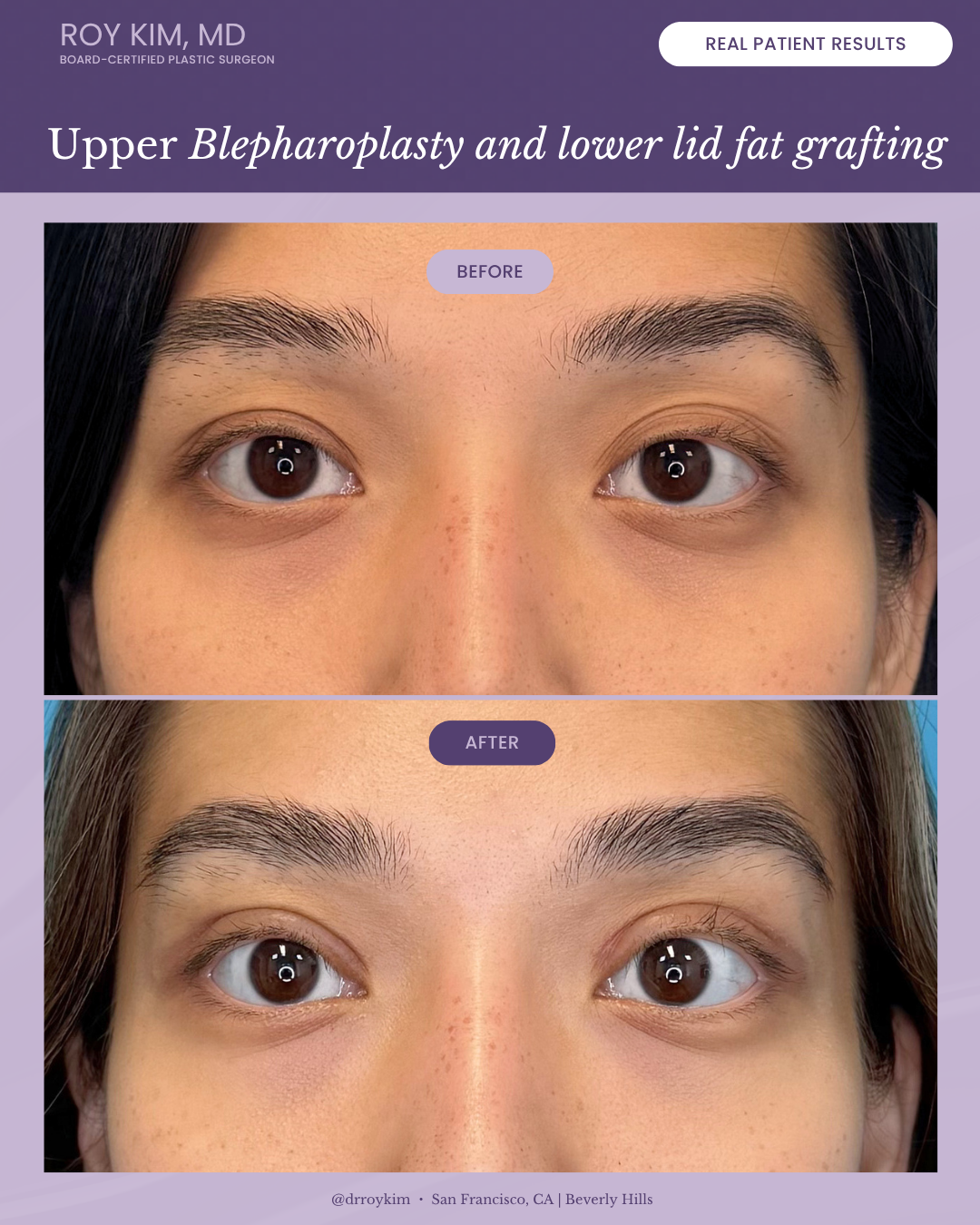
Overview
Upper blepharoplasty is not just skin removal. The real surgical decisions are where to place the incision, how much skin to remove, whether any muscle should be removed, and whether upper-eyelid fat should be preserved, reduced, or repositioned.
For most patients, I want to remove enough excess skin to improve hooding, while preserving the natural fullness and shape of the upper eyelid. Too much skin, muscle, or fat removal can make the eyes look tight, hollow, or operated on.
The scar is usually placed in the natural upper-eyelid crease, where it becomes much less noticeable as it heals. The best technique depends on the patient's anatomy, brow position, eyelid fullness, and how much true excess skin is present.
This article focuses specifically on upper-eyelid technique. For a broader overview of eyelid surgery, including candidacy, upper versus lower blepharoplasty, recovery, and results, see my San Francisco blepharoplasty guide.
1. Where Is the Upper Blepharoplasty Incision?
The incision is usually placed within the natural upper-eyelid crease. Once the incision heals, the scar is largely hidden when the eyes are open. The incision may extend somewhat toward the outer corner of the eye when there is significant lateral hooding.
There is no single incision design that is correct for every patient. Eyelid anatomy, sex, ethnicity, brow position, existing eyelid crease, and the amount of excess skin all influence the design. [1]
2. How Much Skin Should Be Removed?
Enough to improve the hooding, but not so much that the eyelid becomes overly tight.
Removing too little skin may leave residual heaviness. Removing too much can interfere with comfortable eyelid closure and create an unnatural appearance.
The brow also matters. Sometimes what appears to be “extra eyelid skin” is partly caused by a low eyebrow. Upper blepharoplasty cannot automatically correct eyebrow ptosis or eyebrow sag, so the entire upper face should be evaluated rather than simply looking at the eyelid skin.
3. Should Upper Eyelid Muscle Be Removed?
Sometimes, but certainly not in every patient. Under the eyelid skin is the orbicularis oculi muscle, which helps close the eye. Older blepharoplasty techniques commonly removed a strip of this muscle along with the skin.
Today, many surgeons are considerably more conservative.
Preserving orbicularis can help maintain normal eyelid fullness and function. Selective muscle removal can still be useful in certain patients, but routine aggressive removal can contribute to an overly hollow or skeletonized appearance. [1,2]
In practice, I think the question should be: Does removing this muscle actually improve this patient's result? If it does not, there is little reason to remove it.
4. Should Fat Be Removed During Upper Blepharoplasty?
Only when the fat is truly contributing to the problem.
The upper eyelid contains orbital fat compartments. Some patients have a prominent medial fat pad near the inner portion of the eyelid that creates noticeable fullness.
Selective fat removal may improve that contour, but more fat removal is not necessarily better.
One of the major changes in modern upper blepharoplasty has been the recognition that facial aging also involves volume loss. Removing too much upper-eyelid fat can create a deep, hollow upper sulcus that may actually make the face look older. Fat can therefore be preserved, conservatively reduced, or occasionally repositioned depending on the patient's anatomy. [2,4]
5. Is Upper Blepharoplasty Basically the Same Operation for Everyone?
Not at all!
One patient may need primarily skin removal. Another may benefit from skin removal with a small amount of medial fat reduction. Another may benefit from preservation of essentially all the muscle and fat.
Patients with ptosis, brow descent, asymmetry, dry-eye symptoms, previous eyelid surgery, or different underlying eyelid anatomy may require a substantially different plan.
The operation should fit the eyelid, rather than forcing every eyelid into the same operation.
6. What Happens to the Upper Blepharoplasty Scar?
Upper eyelid scars have an important anatomical advantage: much of the incision sits directly in the eyelid crease.
Early scars may look pink, slightly raised, firm, or more noticeable than patients expect. They generally mature and become less conspicuous with time.
Scar quality depends on more than just where the incision is placed. Precise closure and minimizing excessive tension across the wound are also important. Evidence reviews of upper blepharoplasty scars emphasize meticulous surgical technique and appropriate tension management. [3]
To see how swelling, bruising, and the scar change over time, read my guide to upper blepharoplasty recovery: timeline, risks, and what to expect.
7. What Makes an Upper Blepharoplasty Look Natural?
A natural result should not simply look like a large amount of tissue was removed.
The goal is to preserve the characteristics that make the patient's eyes look like their own while reducing heaviness and excess skin. This often means conservative skin removal, selective rather than automatic muscle removal, and preservation of upper-eyelid volume whenever possible.
Upper Blepharoplasty Myths
Myth: More skin removal produces a better result.
Not necessarily. Excessive skin removal can make the eyelid tight and unnatural.
Myth: All upper-eyelid fat should be removed.
No. Fat removal should be selective. Excessive fat removal can produce an older, hollow appearance.
Myth: The muscle always needs to be removed.
It does not. Modern techniques frequently preserve much or all of the orbicularis muscle.
Myth: Upper blepharoplasty leaves no scar.
There is an incision, but the advantage is that most of it can usually be positioned within the natural upper-eyelid crease.
Frequently Asked Questions
Where is the upper blepharoplasty scar?
Most of the scar is positioned in the natural eyelid crease, sometimes extending laterally depending on the amount and location of excess skin.
Does fat always need to be removed?
No. Some patients benefit from selective fat removal, while others are better served by preserving their upper-eyelid volume.
Can upper blepharoplasty fix a low eyebrow?
Not necessarily. Brow descent and excess eyelid skin are separate problems, although they frequently occur together.
Can too much tissue be removed?
Yes. Over-resection of skin, muscle, or fat can create functional problems or an unnatural, hollow appearance.
Summary
Upper blepharoplasty is not simply a matter of cutting away extra skin.
Incision design, skin removal, muscle preservation, fat management, brow position, eyelid function, and scar placement all contribute to the final result.
For many patients, the best operation is actually a relatively conservative one: remove what is truly excessive while preserving the structures that give the upper eyelid its natural shape and fullness.
If you are considering upper blepharoplasty, an in-person examination is the best way to determine which of these techniques actually applies to your anatomy.
Citations
1. Rodrigues C, Carvalho F, Marques M. Upper Eyelid Blepharoplasty: Surgical Techniques and Results-Systematic Review and Meta-analysis. Aesthetic Plastic Surgery. 2023;47:1870-1883.
2. Miotti G, Di Filippo J, Grando M, et al. Fat management in upper blepharoplasty: Addition or subtraction blepharoplasties, how and when. World Journal of Clinical Cases. 2024;12(16):2796-2802.
3. Aghajani A, Babaei L, Eshraghi B. From Incision to Healing: An Evidence-Based Review of Scar Optimization in Upper Blepharoplasty. Aesthetic Plastic Surgery. 2026;50(2):604-615.
4. Nicodemi EM, Taraschi F. The Role of Nasal Fat Preservation in Upper Lid Surgery and Assessment With the FACE-Q Questionnaire: Innovations in Upper Blepharoplasty. Aesthetic Surgery Journal Open Forum. 2024;6:ojae051.